


Kunliwelding ER4943 Runs Clean on EV Battery Lines
Electric vehicle plants now weld thousands of battery trays and crash structures every week on robotic lines that never sleep. One hesitation in aluminum wire feeding stops the entire cell, breaks takt time, and turns profit into scrap. Aluminum Welding Wire ER4943 has become the choice for these critical 6xxx applications, but only when the feeding system treats it differently than steel or ordinary aluminum wire.
Surface finish decides everything first. The wire leaves the drawing die polished and lightly lubricated. Any scratch or oxide band becomes a shaving point the moment the drive rolls bite. Robots welding thin battery enclosure walls run twenty-meter torch packages. Ordinary wire builds black dust that migrates forward and clogs the contact tip in minutes. ER4943 arrives clean and stays clean, letting tips last entire shifts instead of entire parts.
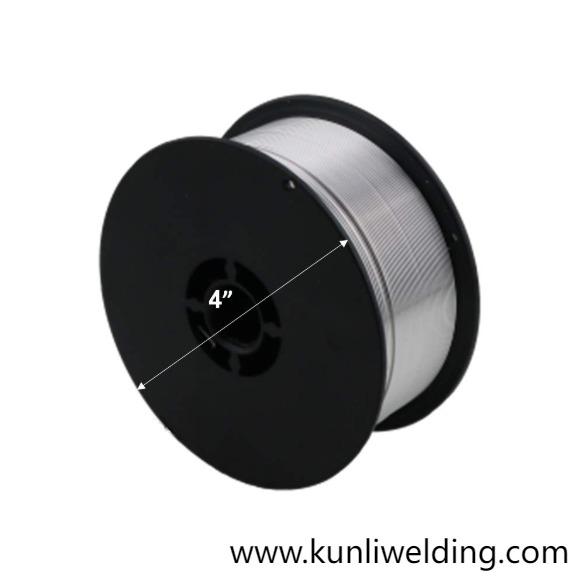
Spool type comes next. Random-wound reels throw loops of different sizes. Large loops slap the conduit walls, small loops dive under previous layers. The soft wire kinks instantly and bird-nests inside the liner. Precision layer-wound plastic spools keep cast constant from outer layer to core. The robot never sees a surge or hesitation, seam tracking stays locked, and the bead stays uniform from corner to corner.
Drive roll profile separates smooth feeding from constant trouble. Steel knurled rolls cut deep into soft aluminum and flatten the wire oval. Oval wire dances in the tip, arc length varies, and the puddle surges. Polished V-knurled or U-groove rolls designed for aluminum grip gently while supporting the wire on multiple sides. ER4943 stays perfectly round from feeder to tip, even through push-pull guns on long boom arms.
Pressure setting feels counter-intuitive. Steel wire needs heavy pinch to move. Aluminum needs only enough to prevent slip. Too much pressure with any roll type flattens ER4943 and creates the same shaving problem. Factories that mark aluminum pressure settings on every feeder and train operators to check them eliminate ninety percent of burn-back and stuttering.
Liner choice matters as much as the wire itself. Standard steel liners shave aluminum constantly. Polished nylon or Teflon liners let the wire glide with almost no resistance. Twenty-five-meter conduits on large battery tray cells stay clean for weeks instead of hours. The robot finishes entire pallets without a single liner change.
Wire cast from the spool affects everything downstream. Poorly wound reels deliver big loops that slam into the rolls and deform instantly. Precision-wound reels produce small, consistent loops that enter the rolls smoothly. ER4943 from controlled spools never gives the drive system a reason to fight.
Inlet and outlet guides complete the chain. Sharp metal edges at the feeder entrance scrape the wire before it even reaches the rolls. Smooth ceramic or plastic guides with large radii let the wire enter straight and untouched. The same care at the gun end prevents kinking just before the tip.
Pulse parameters interact with feeding. Modern pulse programs drop background current low to control heat on thin 6xxx sheet. Wire that hesitates during low current phases causes cold lap. ER4943 with perfect feeding stability lets the power source run aggressive pulse settings without stubbing or burn-back. Travel speed climbs while heat input stays low.
Cold wire versus hot wire preheating shows another advantage. Some plants preheat the wire slightly to improve deposition rate. ER4943 tolerates the extra temperature without softening because its magnesium stays dissolved until the paint-bake cycle. Ordinary silicon wire would lose fluidity.
Repair loops on robot cells reveal the final truth. When a joint fails inspection, the robot must reweld immediately. Ordinary wire that has sat in the gun for hours develops oxide and feeds poorly on restart. ER4943 picks up exactly where it left off, surface still clean, cast still perfect.
Plants building tomorrow's lighter, safer electric vehicles can see the proof at kunliwelding.com. The site shows ER4943 feeding through actual battery tray and crash rail robots, with close-up videos of drive rolls, liners, and spool payoff in real production cells. When the next high-volume 6xxx program demands aluminum MIG wire that disappears into the feeder and lets robots weld hour after hour, the practical feeding photographs and parameter examples waiting at www.kunliwelding.com turn Aluminum Welding Wire ER4943 from temperamental consumable into the invisible part of the process that simply never stops the line.

 English
 Arabic
 French
 Spanish
 Portuguese
 Deutsch
 Dutch
Dutch
 Italiano
 Russian
 Romaian
 Portuguese (Brazil)
 Greek
Greek
