


How Is M Type Metallic Yarn Manufactured?
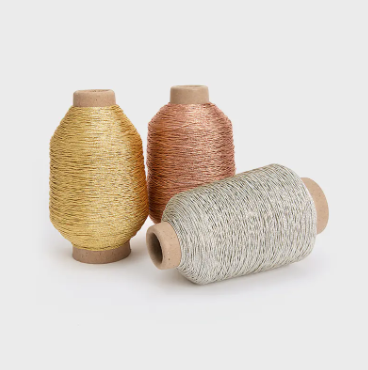
The production process of metallic yarn plays a key role in determining its appearance, stability, and usability in textile applications. Among various structures, M Type Metallic Yarn is widely recognized for its flat reflective surface and stable processing behavior in decorative textile manufacturing.
The manufacturing process starts with polyester film selection, usually PET-based material. The film thickness is commonly controlled within a range of 12μ to 25μ. Thinner films provide higher flexibility, while thicker versions offer improved handling stability during high-speed weaving. After film preparation, a vacuum metallization process is applied, where aluminum is deposited on the surface to create a reflective metallic layer.
Once metallization is completed, the film is coated with a protective epoxy layer. This coating is essential because it prevents oxidation, improves abrasion resistance, and helps maintain shine stability during textile processing. Without this layer, metallic surfaces may lose brightness or degrade under mechanical friction.
After coating, the film is slit into narrow strips. Standard width specifications include 1/69”, 1/100”, and 1/127”, depending on the final application. Narrower widths are typically used in embroidery threads, while slightly wider strips are suitable for weaving decorative fabrics. The cutting precision directly influences yarn uniformity and final fabric smoothness.
One of the important performance factors of M Type Metallic Yarn is its reflective efficiency. Because of its flat surface geometry, light is reflected in a consistent direction, creating a strong visual shimmer. This makes it suitable for applications where surface brightness is a key design requirement.
In terms of mechanical behavior, this yarn has moderate tensile strength because it lacks an additional supporting filament core. For this reason, production settings such as machine tension, needle size, and feeding speed must be carefully controlled. Excess tension may cause micro-cracks in the film structure, leading to reduced continuity during weaving or knitting.
Another technical consideration is heat response. During dyeing or heat-setting processes, temperature levels must be controlled to avoid deformation of the polyester film. Typical industrial processing temperatures are adjusted according to fabric type, but excessive heat exposure can reduce surface gloss or affect dimensional stability.
M Type Metallic Yarn is often used in combination with base yarns such as polyester, cotton, or viscose. This blending approach helps balance aesthetics and fabric comfort. For example, in lace production, metallic yarn provides visual contrast while the base yarn ensures structural softness.
Packaging also plays an important role in maintaining yarn quality. Industrial spools or cones are used to ensure stable unwinding during high-speed production. Proper winding tension helps prevent tangling and supports continuous operation in embroidery and weaving machines.
Overall, the manufacturing process of M Type Metallic Yarn is a combination of material engineering and precision processing. Each stage—from film selection to slitting—directly influences final textile performance, making it a carefully controlled material in decorative fabric industries.

 English
 Arabic
 French
 Spanish
 Portuguese
 Turkish
 Dutch
Dutch
 Italiano
 Russian
 Romaian
 Portuguese (Brazil)
 Greek
Greek
