


How EmizenTech Vets eCommerce Developers: Inside the 6-Stage Process
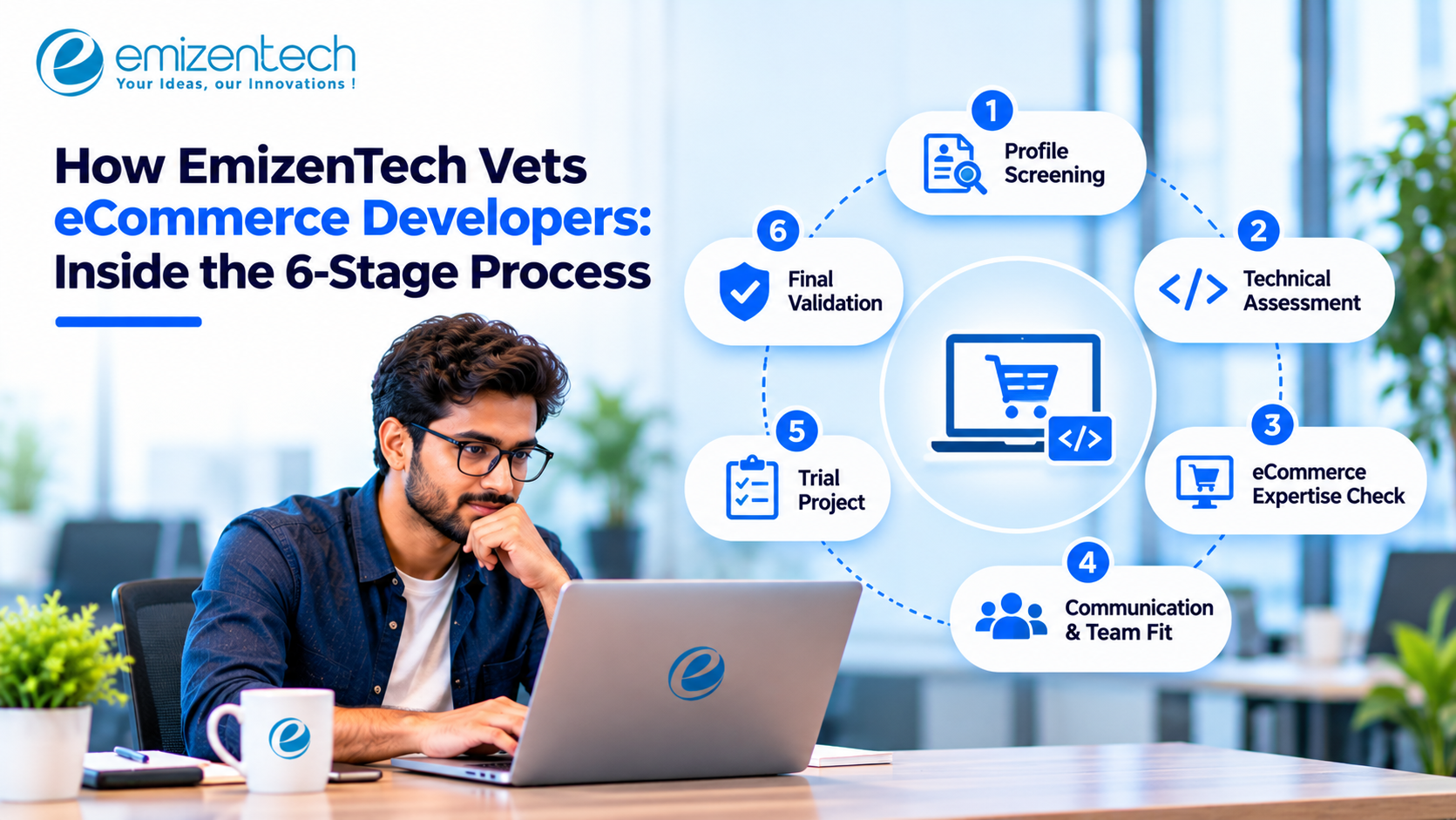
Hiring a developer is a bit like hiring a contractor for your kitchen. The portfolio looks lovely, the quote seems fair, and you only learn about the problems once the walls are open. Vetting is meant to catch those problems early. EmizenTech runs every eCommerce developer through a six-stage screening process, and this article goes through each stage in plain language. What is each step trying to catch? What does it do to your budget? And how can you run a lighter version of the same checks on any provider you’re considering? No technical background needed.
Why Vetting Matters More Than the Hourly Rate
Most owners compare price first. I think that’s backwards. A cheap developer who needs constant correction ends up costing more than a pricier one who gets it right the first time, and the money disappears into rework, delays and weeks of explaining the same thing twice. Vetting is how a provider tries to avoid that before you ever see an invoice.
Anyone planning to hire e-commerce developers should ask one question before talking price: how do you test your people? Find out who does the testing, what the stages are, and what happens to someone who struggles. A clear, step-by-step answer is a good sign. A fuzzy one isn’t, however friendly the sales call felt.
Search for ecommerce developers for hire and you’ll find thousands of profiles that look almost identical. Vetting is what actually separates them.
The Six Stages, One by One
The stages run in a fixed order, and each one filters for something different. A developer can breeze through the first and still stall at the third. That’s by design. Here’s what each stage covers in EmizenTech’s process, and what it’s supposed to catch.
Sourcing and Shortlisting
Candidates get picked from the wider pool here, with the focus on relevant eCommerce experience, proven expertise and a history of delivered projects. In practice that weeds out the generalist who built one theme and now calls themselves a specialist. It’s a basic filter, but plenty of weak hires happen because nobody bothered to apply it.
Technical Screening
Next, each person is checked for technical skill, problem-solving and platform knowledge. That last part matters more than it sounds. Shopify, Magento and WooCommerce behave very differently, and someone strong on one can be merely okay on another. Platform depth is often what separates a ten-day fix from a three-day one.
Live Coding Challenge
Developers complete practical tasks based on real scenarios. I like this stage because it’s hard to bluff. A résumé can claim anything, but a live task shows how someone thinks, what they do when they hit a snag, and whether they ask good questions before typing.
Communication and English Assessment
This one surprises people, and I think it earns its spot. A developer who can’t explain a problem clearly costs you time on every single task. For US clients especially, how well someone writes and speaks affects daily work almost as much as code quality. It’s really about keeping collaboration smooth and everything out in the open.
Trial Period
Selected developers go through a trial to show reliability, adaptability and steady delivery. If I had to rank the six, this and the last one would be at the top, since they happen on real work rather than in a test setting. Real work is where people show their habits.
Ongoing Performance Review
Vetting doesn’t stop once someone’s placed. Developers are evaluated continuously so standards don’t slip. Fair enough, because skills drift and projects change. A developer who was excellent last year isn’t automatically excellent on this year’s platform version.
What You Can Check Yourself
You don’t have to lean on a provider’s process alone. A few simple checks of your own add a second layer, and none of them need you to read code. They also help when several providers all claim to vet carefully, which is most of them. This is the list I’d use.
- Get the process in writing: A real vetting system can be explained step by step. Vague answers usually mean there isn’t one.
- Meet the actual developer: Not the salesperson. Ask about a past project, and what went wrong on it.
- Ask for platform-specific examples: Shopify, Magento, WooCommerce and BigCommerce each demand different skills.
- Read independent reviews: Verified ones on Clutch or GoodFirms say more than a testimonial on the provider’s own site.
- Confirm code ownership: Repositories, hosting and accounts should be in your name from day one.
- Read the refund terms: EmizenTech lists a 14-day money-back guarantee, with the terms published separately. Read them before you count on it.
Rates and Engagement Models
Vetting shapes what you pay, and so does the way you engage someone. A few hours of help and a year of steady development are different purchases, and paying for time you don’t use is the quickest way to waste budget. These are the starting rates EmizenTech publishes for its developers.
| Model | Starting rate | Best for |
|---|---|---|
| Hourly developer | From $20/hour | Short tasks, fixes, quick updates |
| Part-time developer | From $1,200/month | Smaller workloads, ongoing support |
| Full-time developer | From $7,000/month | Steady, dedicated output |
They’re starting points, not quotes. Platform, scope and seniority all move the final number. A theme tweak is cheap, while a multi-vendor marketplace tied into an ERP really isn’t.
If your store needs regular attention, it usually makes more sense to hire dedicated e-commerce developers than to buy scattered hours, because someone who learns your codebase gets quicker as time goes on. Plenty of owners who hire dedicated e-commerce developer help start part-time and scale up only when the backlog justifies it. And before you hire a ecommerce developer for anything big, run a small paid task and see whether the result matches the pitch. It costs little and tells you plenty.
Conclusion
Vetting won’t guarantee a perfect hire. It does remove a lot of avoidable risk. The six stages here (sourcing, technical screening, live coding, communication, trial, ongoing review) cover the main ways a developer can go wrong, from thin skills to poor habits. EmizenTech’s version is one example, and a handy yardstick when you’re comparing other providers. Whoever you pick, ask to see their process and run a small test before you commit to anything large.
If you plan to hire dedicated e-commerce developers, remember that even great vetting can’t replace a clear brief. Know your platform, your workload and your budget before you start talking to anyone.
FAQs
What are the six vetting stages?
Sourcing and shortlisting, technical screening, a live coding challenge, a communication and English assessment, a trial period, and ongoing performance review.
How much does it cost to hire an eCommerce developer?
Published starting rates are about $20 an hour, $1,200 a month for part-time and $7,000 a month for full-time. Final cost depends on platform, scope and experience.
Is there a money-back guarantee?
EmizenTech lists a 14-day money-back guarantee, with separate terms. Read them before you sign, because conditions vary.
Which platforms do the developers work with?
Shopify, Magento (Adobe Commerce), WooCommerce, BigCommerce, Shopware, OpenCart, PrestaShop and Salesforce Commerce Cloud, among others.
Should I choose a freelancer or a dedicated developer?
A freelancer suits a one-off fix. For regular work, a dedicated developer usually wins, because they learn your setup and stay available.

 English
 Arabic
 Spanish
 Portuguese
 Deutsch
 Turkish
 Dutch
 Italiano
 Russian
 Romaian
 Portuguese (Brazil)
 Greek
