


Rubber Board Dealer Licence in India: Eligibility, Documents and Application Process
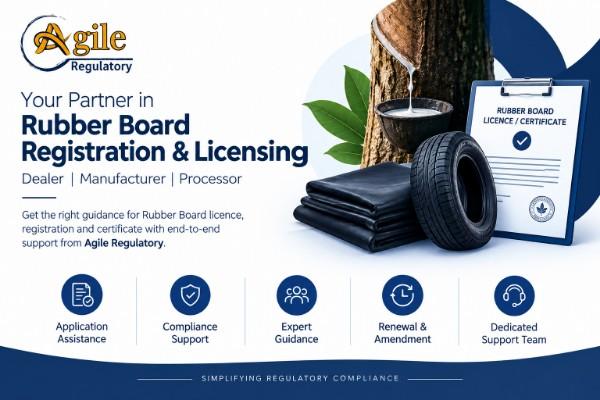
Businesses involved in buying and selling natural rubber often search for information about rubber board dealer license requirements. The terminology can be confusing because people may also search for "Rubber Board registration," "Rubber Board certificate" or "rubber licence."
The important point is that a business should identify the correct licensing category based on its actual activity instead of relying only on the keyword used in an online search.
This guide explains the dealer licensing process in simple language and highlights practical points that new applicants should understand.
What Is a Rubber Board Dealer Licence?
A Rubber Board dealer licence is the regulatory licence applicable to eligible businesses dealing in natural rubber under the relevant provisions administered by the Rubber Board.
The Rubber Board's Licensing Division specifically handles the issue and renewal of licences for rubber dealers and processors.
The Board states that a dealer who wants a licence in Form C has to apply online in the prescribed Form B with the applicable licence fee.
This is why businesses searching for a rubber board dealer license form should distinguish between the application form and the licence certificate that is ultimately issued.
Why Do Rubber Dealers Need Licensing?
Natural rubber transactions are regulated under the Rubber Act, 1947 and Rubber Rules, 1955. The Rubber Board's Licensing and Excise Duty Department administers several licensing and enforcement functions related to rubber transactions.
Licensing provides a regulatory framework for eligible rubber dealers and helps the authorities monitor transactions.
For a business, having the appropriate licence also helps establish that its activities are being conducted under the applicable regulatory requirements.
Who Should Check Dealer Licensing Requirements?
A business should investigate dealer licensing requirements if it is involved in commercial buying, dealing or related transactions involving natural rubber.
The exact position depends on the nature of the activity.
Before applying, a business should clarify:
- What type of rubber is being purchased?
- Is the business acting as a dealer?
- Where will the rubber be stored?
- What is the business constitution?
- Who owns or possesses the business premises?
- Is there an existing Rubber Board licence?
- Are there additional activities such as processing or manufacturing?
These questions can help determine the appropriate compliance route.
Rubber Board Dealer License Form: What Should Applicants Know?
The Rubber Board's published licensing information states that a dealer seeking a licence in Form C should apply online in the prescribed Form B along with the applicable licence fee.
Therefore, an applicant should not confuse:
Form B → application
with
Form C → dealer licence
The exact online workflow and document requirements should always be checked against the current Rubber Board system before submission.
Documents for Dealer Licence Application
The documents required can vary according to the applicant and business structure.
Applicants should generally be prepared to provide information relating to:
- Applicant identity
- PAN
- Business constitution
- Business address
- Proposed business premises
- Storage premises
- Proof of possession of premises
- Contact details
- Supporting authorisation, where applicable
- Existing licence details, if the application relates to amendment or renewal
The Rubber Board specifically mentions documentary evidence to establish the right of possession of the proposed business premises and storage.
Step-by-Step Dealer Licence Process
Step 1: Understand Your Business Activity
First determine whether the business falls under dealer licensing.
Step 2: Prepare the Business Information
Make sure the legal name, address and constitution of the business are correct.
Step 3: Arrange Premises Documents
Keep documents showing the applicant's right to possess or use the relevant business and storage premises.
Step 4: Complete the Online Application
Submit the applicable application through the Rubber Board's online licensing system.
Step 5: Pay the Applicable Fee
The applicable licence fee should be paid according to the relevant category.
The Rubber Board's licensing information lists a licence fee for dealers and other transaction-related categories, with applicable GST as stated by the Board.
Step 6: Check Application Status
Monitor the application for communication or clarification.
Step 7: Receive the Licence
After approval, the licence is issued in certificate form through the online process according to the Board's published information.
Validity of Dealer Licence
One useful point for applicants is the licence period.
The Rubber Board states that dealer licences are initially issued for three years and subsequently renewed for five years.
Businesses should therefore maintain an internal compliance calendar rather than waiting until the licence is close to expiry.
Dealer Licence Renewal
Renewal is an important part of ongoing compliance.
A dealer should review:
- Licence expiry date
- Business name
- Constitution
- Premises
- Storage location
- Contact information
- Any changes since the previous application
- Applicable fee
- Required supporting documents
If the business has changed its constitution, trade name, premises or other relevant information, the Board's procedures for amendments should also be considered.
The Rubber Board's Licensing Division handles matters including agency registration, branch registration, shifting of business premises and amendments to business records.
Dealer Licence vs Manufacturer Licence
These two requirements should not be confused.
A dealer generally deals in rubber, while a manufacturer may acquire rubber for manufacturing purposes.
The Rubber Board separately handles dealer licences and manufacturer licences through its licensing and excise-related functions.
If a company performs more than one activity, it should examine whether additional permissions or licence arrangements apply.
Common Errors in Dealer Applications
Incorrect Premises Information
A mismatch between the application and supporting premises documents can create unnecessary clarification.
Wrong Business Constitution
The applicant should accurately state whether the business is a proprietorship, partnership, company or another form.
Incomplete Storage Details
Where storage is part of the proposed activity, relevant details should be properly documented.
Confusing Registration With Licensing
Searching for "registration" does not automatically mean the business needs a generic registration certificate.
Ignoring Licence Amendments
If the business changes its address, constitution, name or other material details, the applicable amendment procedure should be checked.
How Agile Regulatory Can Assist
Agile Regulatory provides regulatory compliance support for Indian businesses.
For applicants seeking a rubber board dealer license, our team can assist with:
- Requirement identification
- Application preparation
- Document checklist
- Form-related guidance
- Online application assistance
- Clarification support
- Renewal coordination
The purpose is to make the process easier while keeping the application aligned with the applicant's actual business activity.
FAQs
What is the Rubber Board dealer licence form?
The Rubber Board states that a dealer seeking a licence in Form C applies online using the prescribed Form B along with the applicable fee.
How long is a dealer licence valid?
The Board states that it is initially issued for three years and subsequently renewed for five years.
Is dealer licensing the same as GST registration?
No. GST registration and Rubber Board licensing serve different regulatory purposes.
Can the dealer licence be renewed?
Yes. The Rubber Board's Licensing Division handles renewal of dealer licences.
Does every rubber-related business need a dealer licence?
Not necessarily. The correct category depends on the business activity and applicable Rubber Board provisions.
Final Takeaway
If your business buys and deals in natural rubber, do not rely on a generic online search for "rubber licence." First identify the actual activity and then determine whether the dealer licensing provisions apply.
Understanding the correct rubber board dealer license category and preparing the relevant rubber board dealer license form information accurately can make the application process more organised and reduce avoidable errors.
For professional assistance, Agile Regulatory can help businesses understand and manage the applicable compliance process.

 English
 Arabic
 Spanish
 Portuguese
 Deutsch
 Turkish
 Dutch
Dutch
 Italiano
 Russian
 Romaian
 Portuguese (Brazil)
 Greek
Greek
