


Durable Medical Equipment DME Billing and Coding Company: A Complete Guide for Healthcare Providers
Introduction
Durable Medical Equipment (DME) plays a crucial role in patient care, especially for individuals managing chronic conditions, recovering from surgery, or requiring long-term medical support at home. However, while the clinical value of DME is clear, the billing and coding process behind it is often complex, time-consuming, and highly regulated.
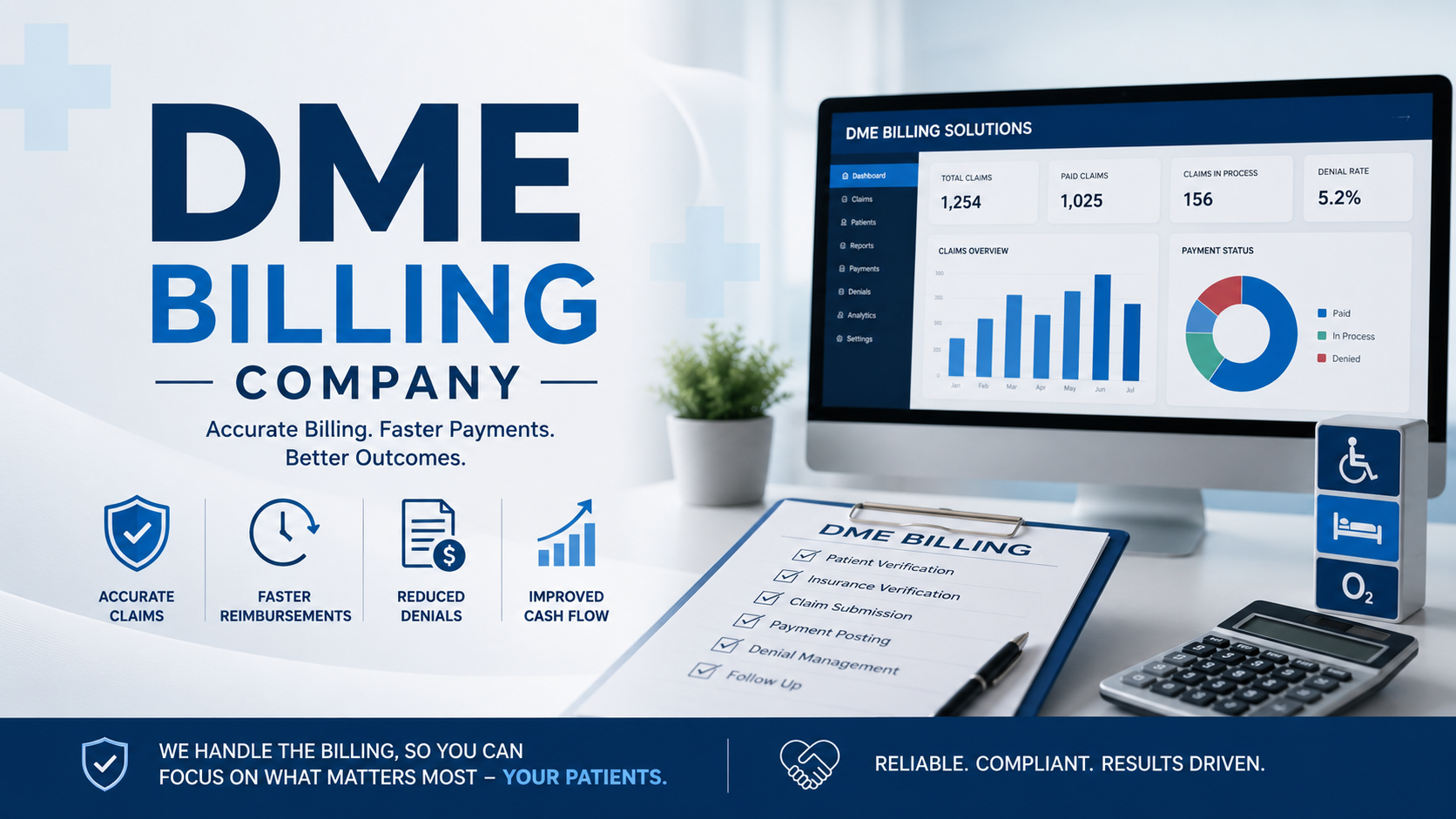
This is where a durable medical equipment DME billing and coding company becomes essential for healthcare providers, suppliers, and medical practices. Accurate billing ensures timely reimbursements, reduced claim denials, and improved revenue cycle performance. On the other hand, even small coding errors can lead to delayed payments or compliance issues.
In today’s competitive healthcare environment, providers are increasingly outsourcing DME billing to specialized experts who understand payer requirements, HCPCS codes, documentation rules, and compliance standards in depth. This blog explains everything you need to know about DME billing and coding, common challenges, best practices, and why outsourcing can transform your revenue cycle.
Understanding Durable Medical Equipment (DME) Billing and Coding
DME refers to medically necessary equipment prescribed by physicians for use at home or in long-term care settings. Examples include wheelchairs, oxygen equipment, CPAP machines, hospital beds, and diabetic supplies.
Billing for these items is not as simple as submitting a standard medical claim. A durable medical equipment DME billing and coding company ensures that every claim follows strict payer guidelines and includes:
- Correct HCPCS Level II codes
- Proper modifiers (KX, RR, NU, etc.)
- Physician prescriptions and Certificates of Medical Necessity (CMN)
- Insurance eligibility verification
- Prior authorization when required
The coding process must align with Medicare Durable Medical Equipment, Prosthetics, Orthotics, and Supplies (DMEPOS) guidelines. Each payer—whether Medicare, Medicaid, or private insurance—has its own set of rules, making accuracy extremely important.
A small error in coding can lead to claim rejection or audit risk. That’s why specialized expertise is critical in this domain.
Key Challenges in DME Billing and Coding
DME billing is one of the most complicated segments in medical revenue cycle management. Providers often face multiple operational and compliance challenges.
1. Frequent Regulatory Changes
Healthcare regulations change regularly, especially in Medicare and Medicaid programs. New codes, revised documentation rules, and updated coverage criteria require constant monitoring. Without expert handling, providers may fall behind on compliance requirements.
2. Complex Documentation Requirements
Each DME claim must be supported by strong documentation such as:
- Physician orders
- Medical necessity proof
- CMN or DWO (Detailed Written Order)
- Delivery confirmation
Missing or incomplete documentation is one of the top reasons for claim denials.
3. High Claim Denial Rates
DME claims are more prone to denials compared to other medical services. Common reasons include:
- Incorrect coding
- Missing modifiers
- Eligibility issues
- Lack of prior authorization
A professional durable medical equipment DME billing and coding company focuses on reducing denial rates through accurate claim submission and proactive follow-ups.
4. Insurance Verification Delays
Before providing equipment, insurance eligibility must be verified. However, delays in verification can slow down the entire revenue cycle, affecting cash flow and patient satisfaction.
5. Compliance Risks and Audits
DME billing is frequently audited by Medicare and private insurers. Any inconsistency in coding or documentation can trigger audits, leading to penalties or repayment demands.
Benefits of Hiring a Durable Medical Equipment DME Billing and Coding Company
Outsourcing DME billing to a specialized company offers significant operational and financial advantages.
1. Improved Revenue Cycle Efficiency
A dedicated billing team ensures claims are submitted faster and more accurately. This leads to quicker reimbursements and improved cash flow for providers.
2. Reduced Claim Denials
Experienced coders understand payer-specific rules and ensure every claim is clean before submission. This significantly reduces rejection rates and rework.
3. Expertise in DME Coding Guidelines
A professional durable medical equipment DME billing and coding company has certified coders who are trained in HCPCS codes, modifiers, and compliance regulations. This expertise ensures every claim meets industry standards.
4. Cost Savings for Providers
Maintaining an in-house billing team requires salaries, training, software, and infrastructure costs. Outsourcing eliminates these overhead expenses while delivering high-quality results.
5. Focus on Core Patient Care
When billing responsibilities are handled externally, healthcare providers can focus more on patient care, service quality, and operational growth instead of administrative burdens.
6. Scalable Solutions
Whether a provider handles a small volume of DME claims or large-scale operations, outsourcing partners can scale services based on business needs.
Best Practices for Accurate DME Billing and Coding
To ensure smooth reimbursement and compliance, healthcare providers and billing companies must follow structured best practices.
1. Accurate HCPCS Coding
Using the correct HCPCS code is essential for every DME item. Even a minor mismatch can lead to claim rejection or delays.
2. Proper Use of Modifiers
Modifiers such as NU (new equipment), RR (rental), and KX (requirements met) must be applied correctly based on payer guidelines.
3. Strong Documentation Management
Maintaining complete and updated documentation is critical. This includes physician orders, patient records, and delivery proofs.
4. Regular Training and Updates
Billing teams should stay updated with CMS guidelines, payer policy changes, and coding updates to ensure compliance.
5. Use of Advanced Billing Software
Automated billing systems reduce human errors, improve claim tracking, and enhance overall efficiency.
6. Pre-Billing Audits
Conducting internal audits before claim submission helps identify errors early and reduces denial rates significantly.
FAQs on Durable Medical Equipment DME Billing and Coding Company
1. What does a durable medical equipment DME billing and coding company do?
A DME billing and coding company handles the entire billing process for medical equipment suppliers, including coding, claim submission, insurance verification, denial management, and reimbursement follow-ups.
2. Why is DME billing more complex than regular medical billing?
DME billing involves strict documentation requirements, frequent regulatory updates, and payer-specific rules, making it more complex than standard medical billing services.
3. How does outsourcing DME billing help healthcare providers?
Outsourcing improves accuracy, reduces claim denials, speeds up reimbursements, and allows providers to focus more on patient care rather than administrative tasks.
4. What codes are commonly used in DME billing?
DME billing primarily uses HCPCS Level II codes along with specific modifiers such as NU, RR, and KX depending on equipment type and payer requirements.
5. Is outsourcing DME billing cost-effective?
Yes, outsourcing is often more cost-effective because it eliminates staffing, training, and infrastructure costs while improving revenue cycle efficiency.
Conclusion
In today’s evolving healthcare landscape, efficient billing is just as important as quality patient care. A professional durable medical equipment DME billing and coding company plays a vital role in ensuring accurate claims, reduced denials, and improved financial performance for providers and suppliers.
With increasing complexity in regulations and payer requirements, outsourcing DME billing has become a practical solution for many healthcare organizations. It not only improves accuracy but also strengthens the overall revenue cycle management process.
Partnering with experienced Medical Billing Services can help healthcare providers streamline operations, ensure compliance, and achieve consistent revenue growth while focusing on delivering better patient outcomes.

 English
 Arabic
 French
 Spanish
 Portuguese
 Deutsch
 Turkish
 Italiano
 Russian
 Romaian
 Portuguese (Brazil)
 Greek
Greek
